
Few things say Central Florida like a sunset from your own dock. Orange County alone has hundreds of named lakes, and lakefront homes in Orlando range from cozy ranch homes on small neighborhood lakes to landmark estates on the Butler Chain. But two homes with the same water view can offer very different lifestyles, costs and rules.
Before you fall for the view, it helps to understand how the major lake chains differ, what you can and cannot build at the shoreline, and which questions to settle before your inspection period ends. This guide covers all three.
Lakefront, Lake Access or Lake View: Know What You Are Buying
Listings use these terms loosely, so read the details carefully:
- Lakefront means the property itself touches the water. You may be able to build or keep a private dock, subject to permits.
- Deeded or community access means you have rights to a shared ramp, park or dock owned by an HOA or the neighborhood. It is often far less expensive than frontage, but rules and fees vary.
- Lake view means you can see the water but have no right to use it from the property.
It also matters which water you are on. A home on a lake that connects to a chain gives you miles of boating. A home on a small, isolated lake offers privacy and calm but limited range. Some canals and lakes also carry no-wake rules or size limits, so a dream ski lake for one buyer may be a quiet paddling lake for another.
The Butler Chain of Lakes: Windermere and Dr. Phillips
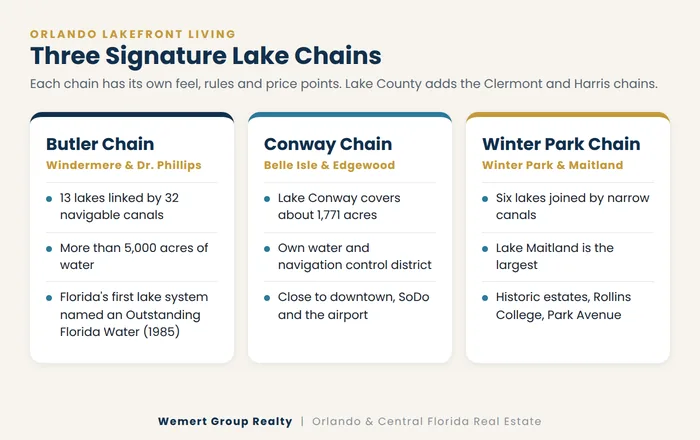
The Butler Chain is Central Florida’s most famous waterfront address. According to the Town of Windermere, the chain includes 13 lakes connected by 32 navigable canals, with more than 5,000 acres of water surrounding the town. Lake Butler and Lake Tibet are the largest. In 1985, it became the first lake system in Florida designated an Outstanding Florida Water, a status tied to its water quality and wildlife habitat.
That designation comes with stricter oversight. Controlling aquatic plants on the Butler Chain requires a permit from the Florida Fish and Wildlife Conservation Commission, and Orange County maintains designated no-wake zones in narrow channels and near shore. Waterfront neighborhoods range from historic homes in the town of Windermere to gated communities such as Isleworth and Keene’s Pointe. Read more about the area in The History and Charm Behind Windermere, Florida, or browse our luxury portfolio.
The Conway Chain: Belle Isle, Edgewood and South Orlando
If you want lake life minutes from downtown, SoDo and Orlando International Airport, look at the Conway Chain. Lake Conway covers roughly 1,771 acres across Belle Isle, Edgewood and unincorporated Orange County, and it connects with Little Lake Conway. Public boat ramps include Randolph Street and Belle Isle’s Perkins ramp.
One detail buyers often miss: the chain has its own special district, the Lake Conway Water and Navigation Control District, which regulates waterways and boating activity. It is funded through a dedicated line on the property tax bill for properties inside the district, and that rate can change from year to year. Ask for the current tax bill on any home you are considering so the number is built into your budget.
The Winter Park Chain: Winter Park and Maitland
The Winter Park Chain offers a different feel: six lakes (Virginia, Mizell, Osceola, Maitland, Nina and Minnehaha) linked by narrow, shaded canals lined with historic homes. Lake Maitland is the largest. Public launches are at Dinky Dock Park on Lake Virginia and Fort Maitland Park, and the city has its own boating rules and permit requirements, so check current details with the City of Winter Park before you plan to keep a boat there.
Homes here pair water access with walkable Park Avenue, Rollins College and some of Central Florida’s oldest neighborhoods. For background, see Winter Park’s history and Maitland’s story.
Beyond Orange County
Lake County offers more space and often more value. The Clermont Chain of Lakes anchors the hills of Clermont, while the Harris Chain connects lakes near Mount Dora, Eustis and Tavares. Seminole County has its own mix of lakefront neighborhoods, which you can explore on our Seminole County lakefront homes page. Each county sets its own shoreline and dock rules, so the details below are specific to Orange County.
Docks, Seawalls and Shoreline Rules
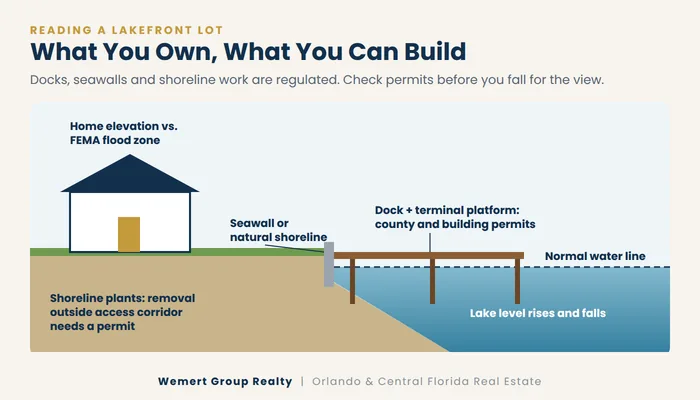
In Orange County, docks are governed by Chapter 15, Article IX of the county code. According to the county’s Environmental Protection Division permitting guide, if you live in unincorporated Orange County, Oakland, Ocoee or Windermere, every new dock needs a permit from the Environmental Protection Division plus a building permit. Docks generally must sit within your shoreline access corridor, and state agencies or the water management district may require their own approvals.
A few practical points for buyers:
- Ask for the dock’s permit history. An existing dock that was never permitted can complicate repairs or replacement later.
- Know the size limits. Terminal platforms, boat lifts and covered structures are restricted. Variances are possible but involve fees and review, and some require a public hearing.
- Inspect the seawall. Repairing or replacing a seawall may require a permit, and a failing wall is a significant expense.
- Leave the shoreline plants alone until you check. Removing vegetation outside your access corridor typically requires a lakeshore protection permit.
Flood Zones, Insurance and Lake Levels
Lakefront homes deserve extra attention on flood risk. Check the property’s FEMA flood zone and ask whether an elevation certificate is available. If the home is in a high-risk zone and you are using a federally backed mortgage, your lender will require flood insurance, which is a separate policy from homeowners coverage. Even outside high-risk zones, a flood quote is worth getting.
Lake levels also rise and fall with rainfall. Extended dry periods can leave a dock sitting above the water, while major storms can push water toward yards and structures. Ask the sellers how the property handled recent hurricane seasons, and look up water quality data for the specific lake on the Orange County Water Atlas. For homeowners coverage, the same inspections apply as for any Florida home: see our guide to wind mitigation and 4-point inspections.
Lakefront Buyer’s Due Diligence Checklist
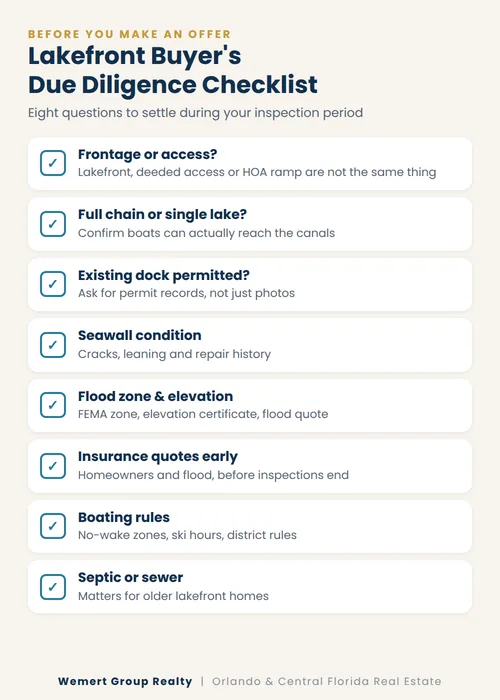
- Confirm whether the home has true frontage, deeded access or HOA access.
- Verify that the lake connects to the chain and that your boat can navigate the canals.
- Request permit records for the dock, boat lift and seawall.
- Have the seawall and dock inspected along with the home.
- Check the FEMA flood zone, elevation certificate and flood insurance quote.
- Get homeowners and flood insurance quotes before your contingency deadline.
- Review boating rules, no-wake zones and any special district assessments.
- Ask whether the home is on septic or sewer, which matters for many older lakefront homes.
Is a Lakefront Home a Good Investment?
Waterfront supply in Central Florida is limited, especially on the established chains, and well-located lakefront homes have historically held strong demand from buyers relocating to the area. At the same time, lakefront homes usually come with higher prices, higher insurance and maintenance costs, and more regulation. The best purchases tend to be the ones where buyers understood those costs up front and chose a lake that fits how they will actually use it.
Frequently Asked Questions
Can I build a dock on any lakefront lot?
Not automatically. Docks require permits, must meet setback and size rules, and are generally limited to your access corridor. Some lots with wetlands or conservation areas face added restrictions.
Do lakefront homes in Orlando need flood insurance?
It depends on the flood zone and your loan type. Homes in high-risk zones with federally backed mortgages require it, and many lakefront owners outside those zones choose to carry it anyway.
Which lake chain is most convenient for commuting?
The Conway Chain sits closest to downtown Orlando and the airport. The Butler Chain is near Dr. Phillips, Restaurant Row and the attractions corridor, and the Winter Park Chain puts you just north of downtown with quick access to I-4. The right choice depends on where you work and how you plan to use the water.
What about alligators?
Alligators live in most Central Florida freshwater lakes. Residents keep pets and small children away from the water’s edge, never feed wildlife, and report concerns to the Florida Fish and Wildlife Conservation Commission.
Find Your Place on the Water
Lakefront buying rewards local knowledge. At Wemert Group Realty, we help buyers compare lakes, review permits and insurance early, and negotiate with confidence. Browse our lakefront homes for sale in Orlando, start with our buyer’s guide, or call us at (321) 567-1202 to talk about the lake life that fits you.
This article is general information. Permitting rules, district assessments and boating regulations change, so verify current requirements with the county, city and relevant agencies before you buy or build.
