
When Orlando buyers build a budget, they usually focus on price, interest rate and down payment. Then the insurance quote arrives and the monthly payment jumps. As we covered in The True Cost of Owning a Home in Florida in 2027, homeowners insurance is one of the biggest variables in what you will actually pay each month.
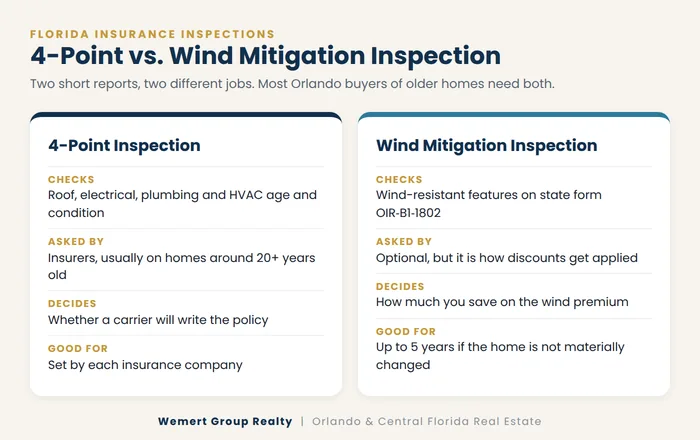
Two short inspections have an outsized effect on that number: the 4-point inspection and the wind mitigation inspection. Each takes about an hour, costs a fraction of a typical annual premium, and can decide whether a home is insurable at all and how much you pay for the wind portion of your policy. In 2026, Florida also rolled out a revised wind mitigation form, so even buyers who have been through this before should know what changed.
What Is a 4-Point Inspection?
A 4-point inspection is a short report from a licensed inspector that documents the age and condition of four systems: the roof, electrical, plumbing and HVAC. It is not a full home inspection. It exists for one audience, the insurance underwriter, who wants to know whether the home’s major systems are likely to cause a claim.
No Florida statute requires a 4-point inspection. Each insurance company sets its own rule, and most ask for one once a home reaches roughly 20 years old, though some carriers start at 15 years and others at 25 or 30. In Orlando, that covers a large share of resale homes in established areas like Conway, Azalea Park, Winter Park, Altamonte Springs, Casselberry and much of East Orlando.
What commonly causes problems on a 4-point
- Roof: age, missing or curling shingles, active leaks or visible wear
- Electrical: panel brands many insurers will not accept, such as Federal Pacific or Zinsco, aluminum branch wiring, double-tapped breakers or undersized service
- Plumbing: polybutylene or galvanized supply lines, active leaks and older water heaters
- HVAC: equipment age and whether the system is working properly
A 4-point typically costs about $75 to $200, and many inspectors offer a discount when you bundle it with a full home inspection and a wind mitigation inspection.
The roof age question
Roof age is where most insurance surprises happen. Under Florida Statute 627.7011, an insurer may not refuse to issue or renew a homeowners policy solely because of roof age if the roof is less than 15 years old, or if it is 15 years or older and an authorized inspector determines it has at least five years of useful life remaining. That protection matters, but carriers can still decline a roof for condition. Ask early for the roof permit date and any repair records so you are not guessing.
What Is a Wind Mitigation Inspection?
A wind mitigation inspection documents the features that help a home resist hurricane winds. The inspector records findings on the state’s Uniform Mitigation Verification Inspection Form, OIR-B1-1802, and Florida law requires insurers to offer premium discounts for qualifying features. The form is valid for up to five years as long as no material changes are made to the home.
Unlike the 4-point, nobody forces you to get one. But it is the only way most carriers will apply wind credits, and Central Florida is not immune to hurricanes. Ian in 2022 and Milton in 2024 both brought damaging winds well inland, and insurers price that risk into every Orlando policy.
What changed on the 2026 form
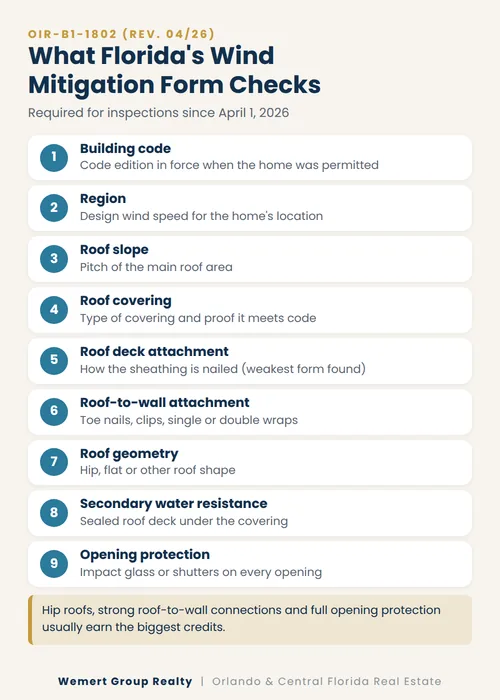
Beginning April 1, 2026, inspectors must use the revised OIR-B1-1802 (Rev. 04/26), the first major update in more than a decade. The new version expands definitions and evaluates the nine features shown here.
If you already have a report on the older version, it may still count. Citizens Property Insurance, for example, continues to accept the prior form if it was completed within five years before April 1, 2026 and the structure has not changed. Other carriers set their own policies, so confirm with your agent.
What the wind mitigation form does not do
The form verifies construction features only. It is not proof of roof condition or of a roof replacement, which is why many older homes need both reports. A home can earn strong wind credits and still need a 4-point that shows the roof, panel and plumbing are in acceptable shape before a carrier will write the policy.
Roof-to-wall connections: where the savings often hide
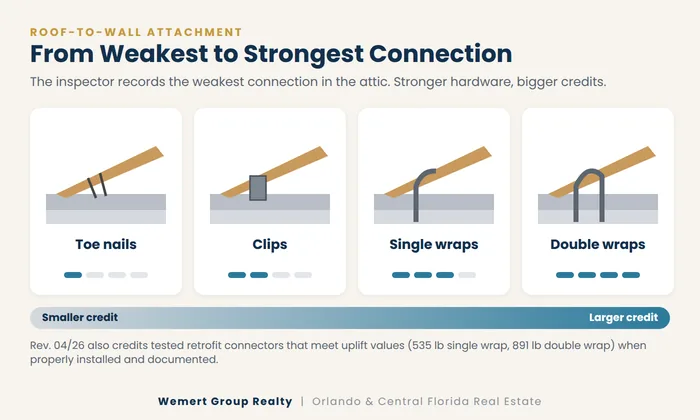
The inspector checks the attic and records the weakest roof-to-wall connection found. Toe nails earn the least credit, followed by clips, single wraps and double wraps.
One of the most useful changes in the 2026 form is the addition of performance-based retrofit options. Engineered connectors that meet set uplift values, such as 535 lb for single wraps and 891 lb for double wraps, can now qualify when they are installed to the manufacturer’s specifications and properly documented. If you are replacing a roof, ask your roofer about adding rated connectors while the edge of the roof is open. Keep every invoice and product approval, because the hardware may be hidden from the next inspector.
Hip roofs and opening protection
Roof shape and opening protection also carry real weight. A hip roof, which slopes down on all sides, generally performs better in high winds than a gable roof. Opening protection credits require protection on every opening, including windows, doors, skylights and the garage door. One unprotected opening can drop you to a lower category, so a single impact garage door can be a surprisingly valuable upgrade.
How Orlando Buyers Should Use These Inspections
The goal is simple: know your real insurance cost before your inspection period ends, while you still have leverage.
- Ask for the seller’s existing reports. A wind mitigation report under five years old, on an unchanged home with a matching address, may be usable for your policy.
- Schedule both inspections inside your inspection period, alongside your full home inspection. Bundling saves time and money.
- Get insurance quotes before your contingency deadline. Share both reports with your agent. Our home buyer insurance guide explains what to ask.
- Negotiate with the findings. An older roof or a problem panel is a legitimate reason to request a repair, a credit or a price adjustment, especially now that Orlando has shifted toward a buyer’s market.
- Plan upgrades with the report in hand. The wind mitigation report shows exactly which improvements would move you into a higher credit category.
My Safe Florida Home: Free Inspections and Grants
The My Safe Florida Home program, run by the Florida Department of Financial Services, has offered free wind mitigation inspections and matching grants of up to $10,000 for upgrades such as impact windows, doors and roof improvements. Funding depends on yearly appropriations from the Legislature, recent cycles have limited grant eligibility by income and priority group, and grants are paid as reimbursements after approved work is complete. If you are buying an older home, check the program’s current status before you plan on it, because it can change from one funding cycle to the next.
Tips for Sellers: Make Your Home Easier to Insure
With more inventory on the market, an insurance-ready home stands out. Before listing, consider ordering your own 4-point and wind mitigation inspections. Fix small electrical and plumbing items flagged in the report, and gather your roof permit, impact window and door invoices, and any product approvals. Handing buyers a clean set of reports removes a common source of last-minute stress and gives them confidence to write a stronger offer. Our 2027 pricing and prep guide for Orlando sellers covers the rest of the preparation list.
Frequently Asked Questions
Do new construction homes need a 4-point inspection?
Usually not, since the systems are new. A wind mitigation inspection is still worth getting, because newer homes often qualify for strong credits. If you are weighing options, see Orlando New Construction vs. Resale.
Who can perform these inspections?
Florida-licensed professionals such as home inspectors, building inspectors, general contractors, architects and engineers. Your insurer may have its own requirements, so ask before you book.
Does a wind mitigation report stay with the house?
The report describes the structure, not the owner, so many carriers will accept a valid report from the previous owner if it is within five years and nothing material has changed. Confirm with your agent before you rely on it.
How long does each inspection take?
Most take 30 to 60 minutes, and reports are often delivered within a day or two.
Buy With Your Real Monthly Payment in Mind
At Wemert Group Realty, we help Central Florida buyers look past the list price to the true cost of ownership, from inspections and insurance quotes to negotiating repairs that keep a home insurable. If you are starting your search, explore our Orlando buyer resources, connect with one of our preferred lenders, or call us at (321) 567-1202. We would be glad to help you buy with confidence.
This article is general information, not insurance or legal advice. Underwriting rules vary by carrier and change over time, so confirm current requirements with a licensed insurance agent.
