
Owning a vacation home near Walt Disney World is a goal for many investors and second-home buyers. Central Florida draws visitors year-round, and a well-run rental can help cover the cost of a home you also enjoy yourself.
But the most important question is not price or bedroom count. It is whether the home can legally be rented by the night. In the Disney area that answer depends on which county and city the home is in, how the parcel is zoned, and what the HOA allows. Two homes a few miles apart can have completely different rules, and buying the wrong one can turn an investment into a long-term rental you never planned on.
Three Layers Every Vacation Rental Must Clear
The state. Florida requires a vacation rental license from the Department of Business and Professional Regulation (DBPR) for homes and condos rented to guests more than three times a year for stays under 30 days, or advertised as regularly rented. State law also limits local governments: since 2011, cities and counties generally cannot ban vacation rentals outright or regulate how long or how often guests stay, although zoning rules adopted before then still apply. A 2024 bill that would have rewritten this framework was vetoed, so that structure remains in place.
The local government. Zoning still decides where short-term rentals fit, and each county and city draws those lines differently. That is why the county name on the tax bill matters more than the address on the listing.
The community. Even where zoning allows short-term rentals, HOA or condo documents can prohibit them, set minimum stays, or require registration with the association. Always read the declaration and rules before you make an offer.
Orange County: The Strictest of the Three
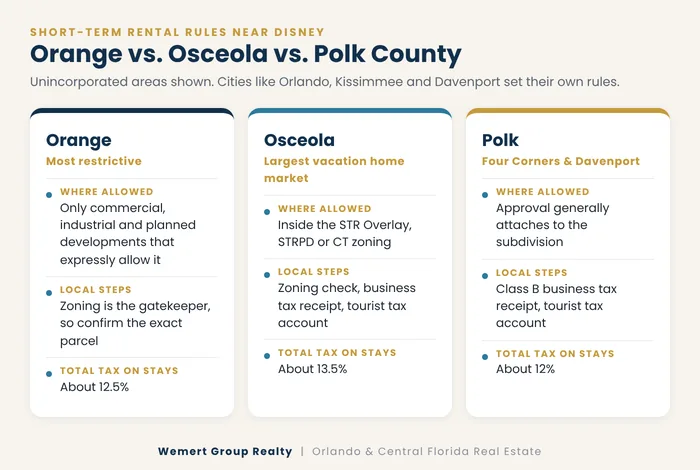
Orange County includes Disney’s own property, Lake Buena Vista and the International Drive corridor, yet it is the most restrictive county for vacation homes. According to the county’s Zoning Division, short-term rental, defined as a stay of 179 days or less, is permitted only in commercial C-1, C-2 and C-3 districts, certain industrial districts, and planned developments where it is expressly allowed. In every other district, it is prohibited.
Cities add their own layer. Inside Orlando city limits, renting an entire home short-term is limited to certain commercial and mixed-use districts, while owner-occupied home sharing is allowed with registration. Many master-planned communities, including much of Lake Nona, also restrict short-term rentals through their HOA rules.
Bottom line: in Orange County, a home being near Disney does not make it eligible. The parcel’s zoning has to say so.
Osceola County: The Heart of the Vacation Home Market
Most of the classic Disney-area vacation home communities sit in Osceola County, along the US 192 corridor and around ChampionsGate, Reunion and Windsor Hills. Many of these resort communities were planned specifically for short-term rentals, with clubhouses, water parks and on-site management.
The rules are still specific. In unincorporated Osceola County, short-term rentals are allowed only in areas covered by the county’s Short-Term Rental Overlay, the Short Term Rental Planned Development (STRPD) district, and the Commercial Tourist (CT) district. The county’s STRPD page tells owners to verify zoning on the overlay map first. Celebration, for example, sits in Osceola County but outside the overlay, so it is not a short-term rental community.
The City of Kissimmee has its own overlay and requires a conditional use approval in some districts. If a listing says Kissimmee, confirm whether the home is inside city limits or in unincorporated Osceola County, because the process differs.
Polk County: Four Corners and Davenport
West of ChampionsGate, the Four Corners and Davenport area in Polk County has become a major vacation rental market, often with lower prices than comparable Osceola communities. In unincorporated Polk County, short-term rental approval generally attaches to the subdivision rather than to an individual home, so you need to confirm that the specific community was approved for that use.
Operators need a Class B county business tax receipt for rentals of six months or less, plus a tourist development tax account with the Polk County Tax Collector. The City of Davenport and other Polk cities set their own requirements, so check city limits here too.
Taxes Every Vacation Rental Owner Collects
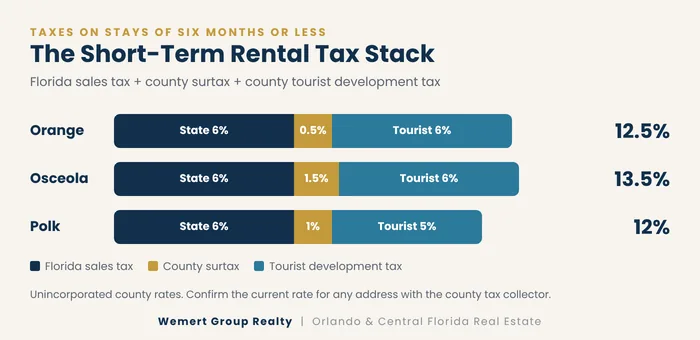
Florida taxes stays of six months or less like hotel rooms. Guests pay the 6% state sales tax, the county’s discretionary surtax and the county tourist development tax. In unincorporated areas, that adds up to about 12.5% in Orange County, 13.5% in Osceola County and 12% in Polk County, where the tourist development tax rate is 5%. Some booking platforms collect certain taxes for you, but owners remain responsible for anything that is not collected.
Property taxes work differently for investment homes, too. A vacation rental does not qualify for the homestead exemption, and assessed value increases on non-homestead property are capped at 10% per year instead of 3%. Build that into your projections, and talk with a tax professional about income tax on rental revenue.
Due Diligence Before You Make an Offer
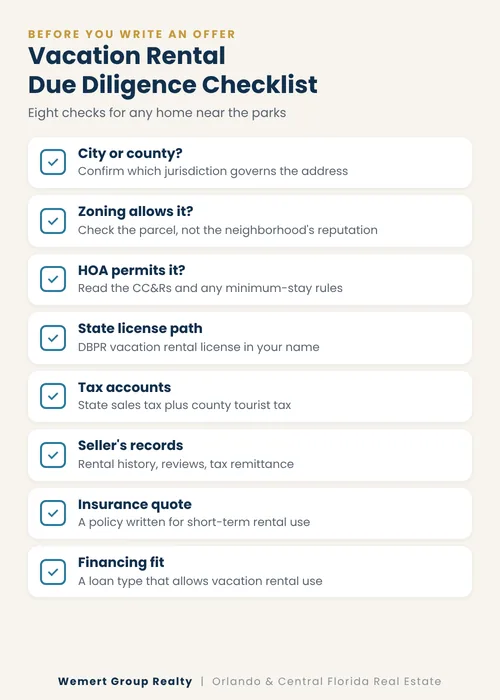
Use your inspection period to confirm every layer, not just the home’s condition:
- Confirm whether the address is in a city or unincorporated county.
- Verify zoning for the exact parcel, not the neighborhood’s reputation.
- Read the HOA documents for rental rules, minimum stays and fees.
- Plan your DBPR license application, since the license does not simply transfer to a new owner.
- Set up state and county tax accounts before your first booking.
- Ask the seller for rental history, reviews and proof of tax remittance.
- Get an insurance quote for a policy written for short-term rental use.
- Choose financing that allows vacation rental use.
Running the Numbers
Gross bookings are only the start. A realistic projection includes property management fees, cleaning, furnishing and replacing furniture, utilities, internet, pool and lawn service, HOA dues, insurance, taxes and repairs. Resort communities often carry higher HOA fees in exchange for amenities that help bookings. Insurance for a short-term rental also costs more than a standard homeowners policy, and the same wind mitigation and 4-point inspections that help any Florida homeowner can lower your premium.
Financing matters as well. Lenders treat second homes and investment properties differently, and some loan types limit how often a home can be rented. Talk with one of our preferred lenders early. And with more inventory available, today’s buyer’s market can give investors room to negotiate furnishings, closing costs or repairs into the deal.
Common Mistakes to Avoid
The most expensive mistake is assuming a home is rentable because nearby homes appear on booking sites. Some of those listings may be operating without approval, and enforcement can catch up with the next owner. Treat a neighborhood’s reputation as a starting point, never as proof.
Other common missteps include relying on a seller’s projected income without seeing actual booking records, overlooking HOA rule changes that can tighten rentals after you buy, and underestimating how seasonal Disney-area demand can be. Ask for at least a full year of performance data, and stress-test your numbers with lower occupancy than the seller reports.
Frequently Asked Questions
Can I rent out my Orlando home on Airbnb?
Only if the zoning, any city rules and your HOA all allow it. In most residential neighborhoods in Orange County and the City of Orlando, renting an entire home for short stays is not permitted.
Do I need a license if I only rent a few times a year?
Florida’s vacation rental license applies to homes rented more than three times a year for stays under 30 days, or advertised as regularly rented. Local tax registration may still apply, so confirm with DBPR and the county.
Is Celebration a vacation rental community?
No. Celebration is outside Osceola County’s short-term rental overlay, so nightly rentals are not allowed there.
Which county is best for a Disney-area vacation rental?
Osceola County has the largest concentration of purpose-built vacation home communities, and Polk County’s Four Corners area offers more options at lower price points. The right choice depends on your budget, the community’s rules and how you plan to use the home yourself.
Buy the Right Vacation Home the First Time
Wemert Group Realty helps investors and second-home buyers sort out the zoning, HOA and licensing questions before they write an offer. Browse our vacation rental homes for sale, learn about real estate near Orlando’s theme parks, or call (321) 567-1202 to talk through your plans.
This article is general information, not legal or tax advice. Zoning, licensing, HOA rules and tax rates change and can vary by address, so verify current requirements with the county, city, DBPR and a qualified professional before you buy.
