
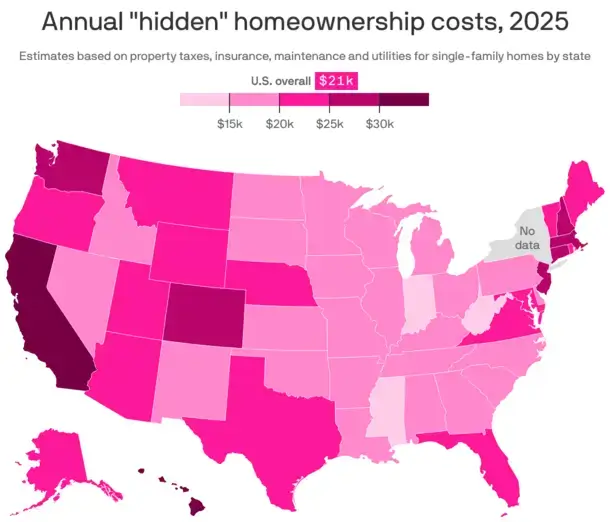
Picture this. You find the perfect home in Florida. The listing says $425,000. Your lender pre-approves you for a mortgage with a monthly principal and interest payment right around $2,400. It fits your budget. You’re ready to move.
Then closing gets close, the escrow numbers come in, and suddenly your real monthly payment is $3,500. Or $3,800. Or, in some neighborhoods, over $4,000.
Where did the extra $1,000 to $1,600 a month come from? Welcome to the true cost of homeownership in Florida.
This is the conversation we have with almost every out-of-state buyer who moves to Central Florida, and even with plenty of Florida natives who are buying their first home. The Sunshine State comes with some incredible perks — no state income tax, year-round sunshine, incredible neighborhoods — but it also comes with a stack of ownership costs that catch buyers off guard if nobody warns them ahead of time.
At Wemert Group Realty, we believe informed buyers make happy homeowners. So let’s walk through every real cost of owning a home in Orlando and across Florida in 2027, what you can expect to pay, and how to protect your budget before you sign anything.
The Florida Ownership Costs Nobody Talks About in the Listing Description
 When you look at a home for sale online, you see the price. Maybe you see the estimated mortgage payment. What you almost never see up front:
- Homeowners insurance
- Flood insurance (in some areas, required)
- Property taxes
- HOA dues
- CDD fees
- Maintenance reserves
Each one of these is a real line item in your monthly budget. Skip one, and your whole plan falls apart. Let’s break each of them down.
Homeowners Insurance: The Number That Shocks Everyone
Let’s just get this out of the way. Florida homeowners insurance is expensive. It is the most expensive in the country. And it is the single biggest surprise for buyers relocating from almost anywhere else.
What you’ll actually pay in the Orlando area:
For a typical single-family home in the Orlando metro valued between $350,000 and $500,000, expect homeowners insurance premiums in the range of $2,200 to $4,000 per year — roughly $185 to $335 per month added to your escrow.
Orlando is inland, which is a huge advantage. Coastal markets like Miami, Naples, and parts of Tampa Bay can see premiums two to three times higher for a similar home. But even by Orlando standards, an older home with an aged roof can push $5,000 or $6,000 per year, while a brand-new home in Lake Nona or Horizon West with hurricane-rated construction and a fresh roof might come in closer to $2,000.
Why Florida insurance costs what it does:
- Hurricane and tropical storm exposure across a six-month season every year
- Sinkhole risk in parts of Central Florida
- Roof age and construction quality (older homes cost dramatically more to insure)
- Years of insurer losses that led to carriers pulling out of the state
- Rebuild cost inflation on materials and labor
The good news for 2027: after several rough years, the Florida insurance market is finally stabilizing. Citizens Property Insurance rolled out its first meaningful rate cuts in years starting mid-2026, and private carriers are slowly returning to the market. Rates are not going back to where they were in 2018, but they have stopped climbing at the pace of the last four years.
How to lower your Florida insurance premium:
- Get a wind mitigation inspection. The updated OIR-B1-1802 form saves Florida homeowners an average of nearly $2,800 per year when the inspection shows hurricane-resistant features
- Check roof age before you make an offer. A roof under 10 years old dramatically lowers your premium. A roof over 15 years old can make some carriers refuse to write the policy at all
- Shop at least three carriers every renewal. This alone can save 20% to 40%
- Bundle home and auto insurance for a 10% to 25% discount
- Install a monitored security system and storm shutters for additional discounts
Never — and we mean never — buy a home in Florida without getting an insurance quote on that specific property before you close. A bad insurance quote can wreck an otherwise perfect deal.
Property Taxes in Orlando: Actually Not That Bad (If You Do This One Thing)
Compared to places like New Jersey, Illinois, or Texas, Florida property taxes are relatively friendly. The statewide average effective tax rate is about 0.91% of assessed value, though real rates in the Orlando area typically run between 0.85% and 1.2% depending on your specific county and municipality.
On a $400,000 home in Orange County, that works out to roughly $3,500 to $4,000 per year, or about $290 to $335 per month added to your escrow.
The Homestead Exemption is your best friend.
If the home is your primary residence, Florida’s Homestead Exemption reduces your assessed value by up to $50,000 for property tax purposes. On a $400,000 home at a 1% tax rate, that saves you roughly $500 per year — every year you own the home.
But the real magic is the Save Our Homes cap. Once your homestead is in place, your assessed value can only increase by a maximum of 3% per year, no matter how much the market value climbs. In a fast-appreciating market like Orlando, this can save you thousands of dollars per year over time. Homeowners who have been in the same home for 10 or 15 years often pay less in property tax than their neighbor who just moved in — sometimes by a huge margin.
Important: You have to apply for the exemption by March 1 of the year after you purchase. Do not forget. Set a calendar reminder the day you close.
HOA Fees: From Zero to $600+ Per Month
 Homeowners Association fees are all over the map in Central Florida. What you pay depends entirely on what kind of community you buy into.
- Older, non-HOA neighborhoods (parts of College Park, Audubon Park, older Winter Park): $0 per month
- Standard single-family HOA communities (much of suburban Orange and Seminole County): $50 to $150 per month
- Master-planned communities with amenities (Lake Nona, Baldwin Park, Horizon West, Nona Terrace): $125 to $300 per month
- Gated luxury communities with clubhouses and golf (Windermere, Isleworth, parts of Dr. Phillips): $300 to $700+ per month
- Condos and townhomes: $400 to $600+ per month (these include exterior maintenance, roof reserves, and building insurance)
What HOA fees typically cover: community pools, gyms, clubhouses, security gates, landscaping in common areas, playgrounds, trails, and sometimes internet and cable.
What to ask before you buy into an HOA:
- Request the last three years of HOA financials and meeting minutes
- Ask about upcoming special assessments (unexpected one-time fees for major repairs)
- Check the reserve fund — a healthy HOA has money set aside for future big-ticket items
- Review the CC&Rs so you know what you can and cannot do with your property
HOA fees also tend to climb over time. Budget for 3% to 5% increases most years.
CDD Fees: The Florida-Only Line Item Most Buyers Have Never Heard Of
This one catches almost every out-of-state buyer by surprise. CDD stands for Community Development District, and it is unique to Florida (and a few other states with similar structures).
Here is how it works. When a developer builds a large master-planned community — think Lake Nona, Baldwin Park, Laureate Park, Waterset, or huge chunks of Horizon West — they take on massive infrastructure costs. Roads, sewer, water lines, community amenities, parks, trails. Instead of paying for it all up front and rolling it into the home prices, the developer floats a 20 to 30 year municipal bond.
That bond gets paid back by the homeowners who live there, through an annual CDD fee that shows up on your property tax bill.
How much are CDD fees? Typically $1,000 to $3,000 per year for most Central Florida master-planned communities. That works out to about $85 to $250 per month.
Two-part fee: most CDDs have a bond portion (the actual infrastructure debt, which eventually gets paid off) and an operations & maintenance portion (ongoing upkeep of community assets, which never goes away).
Important: ask exactly how much of your CDD is bond vs. O&M, and how many years are left on the bond. In some older CDDs, the bond is fully paid off and homeowners only pay the smaller O&M portion.
CDD fees are not a bad thing — they usually mean you’re in a well-planned community with great amenities. You just need to know they exist and budget accordingly.
Flood Insurance: When It’s Required and What It Costs
Even though Orlando is inland, some neighborhoods sit inside FEMA-designated flood zones (parts of southeast Orlando, areas near lakes and retention ponds, and some older neighborhoods with poor drainage).
If your lender requires flood insurance, expect to pay $500 to $1,200 per year through the National Flood Insurance Program, though private flood policies are increasingly competitive and sometimes cheaper.
Always pull the flood zone report on any home you’re serious about before you make an offer. Your Wemert Group agent can do this in about 60 seconds.
Putting It All Together: What a Real Orlando Monthly Payment Looks Like
Let’s run the numbers on a fairly typical Orlando purchase in 2027. Assume a $425,000 home in a Horizon West community, 10% down, 6.5% mortgage rate, standard HOA, and a moderate CDD.
- Principal & interest: $2,420
- Property taxes (with homestead): $310
- Homeowners insurance: $245
- HOA dues: $150
- CDD fee: $170
- PMI (10% down): $135
Total monthly payment: roughly $3,430
That is the real number. Not the $2,420 mortgage payment on the listing page. Buyers who plan for the real number are the ones who feel great about their purchase two, five, and ten years later.
How to Protect Yourself Before You Buy
Five things every Orlando homebuyer should do before signing a contract:
- Get a specific insurance quote on the exact property — before you go under contract if possible
- Pull the flood zone report and roof age on any home you like
- Ask for the last three years of HOA financials if the community has an association
- Confirm the exact CDD amount and remaining bond term on the property record
- Work with a local Orlando real estate agent who lives and breathes this market and knows how to spot the hidden costs before they hit your budget
The Wemert Group Advantage
We have helped thousands of families move to, from, and around Central Florida. We know which neighborhoods carry surprise costs, which HOAs are well-run, which communities have paid-off CDD bonds, and which insurance carriers actually write policies in specific ZIP codes.
If you are thinking about buying a home in Orlando in 2027 — whether you’re relocating from another state or already call Central Florida home — reach out. We’ll sit down with you, walk through your budget honestly, and make sure the home you fall in love with is one you can comfortably afford for years to come.
The true cost of Florida homeownership is real. But with the right team in your corner, it’s also entirely manageable — and the lifestyle payoff is more than worth it.
